Everything from the back of Standards over Moods, with room to breathe. Print what you need, run it tonight.
Best is to read the book first, there’s no shortcut. Just like in school, you learn your abc’s first, then you slowly learn to add to that over time. To benefit from this system, add to it one layer at a time. Those who try and take on the full system all at once will miss out on the details, where the real lessons are hidden.
This is the order to add to it, one layer at a time, with the honest minutes for each. The one rule: add the next layer only once the last one is routine.
Start tonight: the book report. Read about ten pages, then write down three short parts, Summary, Internalization, and Action. This is the real time on the clock, about twenty minutes most nights, sometimes thirty. (How to Read This Book; the template is in The Book Report at the back.)
Next: the nightly review. Once the book report is a habit, add the four end-of-day questions, your PDCA pointed at the day. Three to five minutes once it is routine. (Chapter Five.)
Then: the mood check and the Scan. Once the nightly review holds, add the walk through your four rooms, each checked against its floor, above it, holding it, or below. A small daily addition once it is set up, well under two minutes. (Chapters Two, Four, and Five; the blank Scan is a few pages on.)
Optional: the Priority Sort. Some run the Eisenhower sort in the evening too. If you do, that is another few minutes. (Chapter Four; the blank sort is in these pages.)
Early on, as with anything new, all of it runs longer. Make it a standing part of your day and it becomes the foundation that decides this year, and the years to come.
On a bad week, hold the floor. When everything is on fire and you have nothing left, you do not run the system, you hold the floor in each room, the worst-day minimum you refuse to drop below: the everyday business minimum, the ten-minute walk and the glass of water, the one-line text, one honest rep in Growth. Mark the Scan if you want to keep track. The floor keeps a bad week from turning into a bad month.
A snapshot of the entire system. Four rooms across the top, the six beats down the side. Not every room runs every beat the same way: in Growth, your daily loop is the metric, by design. Each room is explained in full in its own chapter.
| Business | Health | Relationships | Growth | |
|---|---|---|---|---|
| The lie | “Polish is progress.” | “I’ll start tomorrow.” | “I was busy.” | “I’m already growing.” |
| The numbers | Offers made, talks had. | The mirror and the scale. | Be specific. | Your daily PDCA is by design the metric for this room. |
| The floor | The everyday minimum. | A ten-minute walk, a glass of water. | A one-line text. | Show up to the loop. |
| The system | Three clock-in tasks, no mood needed. | Set your surroundings the night before. | Tie check-ins to what you already do. | Catch the Narrator, choose differently. |
| The pillar | Ownership. | Discipline. | Consistency. | Coachability. |
| The rep | Lock the floor, mark it in tonight’s Scan. | Lock the worst-day floor, and Scan it. | One person, phone away. | Run the loop tonight. |
| Tip | Ignore the mood, it has no vote. | Watch out, this is the floor that gets ignored the fastest. Put your supplements where you see them. Get a buddy system going for your walks. | Know that the results will only come over time. |
Every practice in the book, in one place. The first five are the daily and weekly core; run those. The rest are one-time moves you do once and revisit when a room needs it. Each chapter also ends with a one-line Rep.
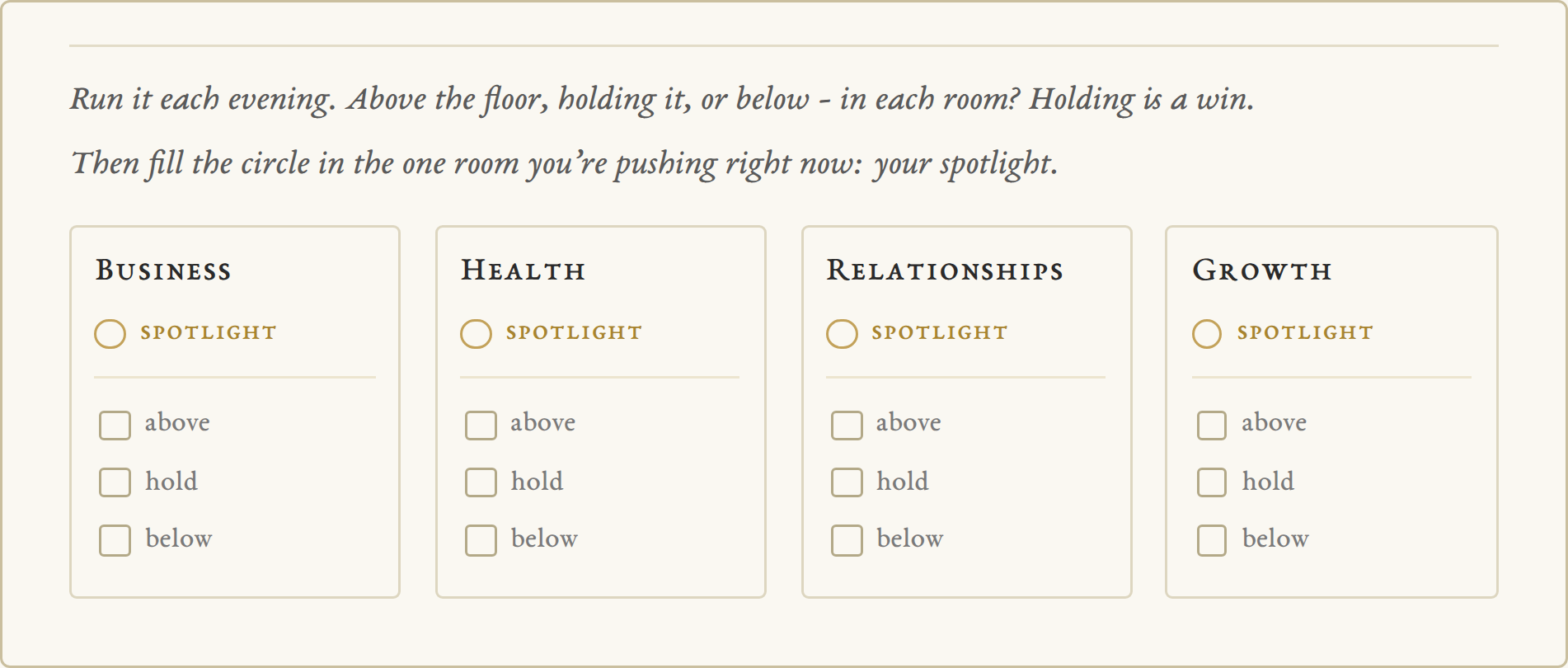
The blank one, yours to run. Copy this page, then each evening stop at every door and mark it: above your floor, holding it, or below. Holding is a win. Below just tells you which room to check first tomorrow, then you adjust one thing.
Open the Scan
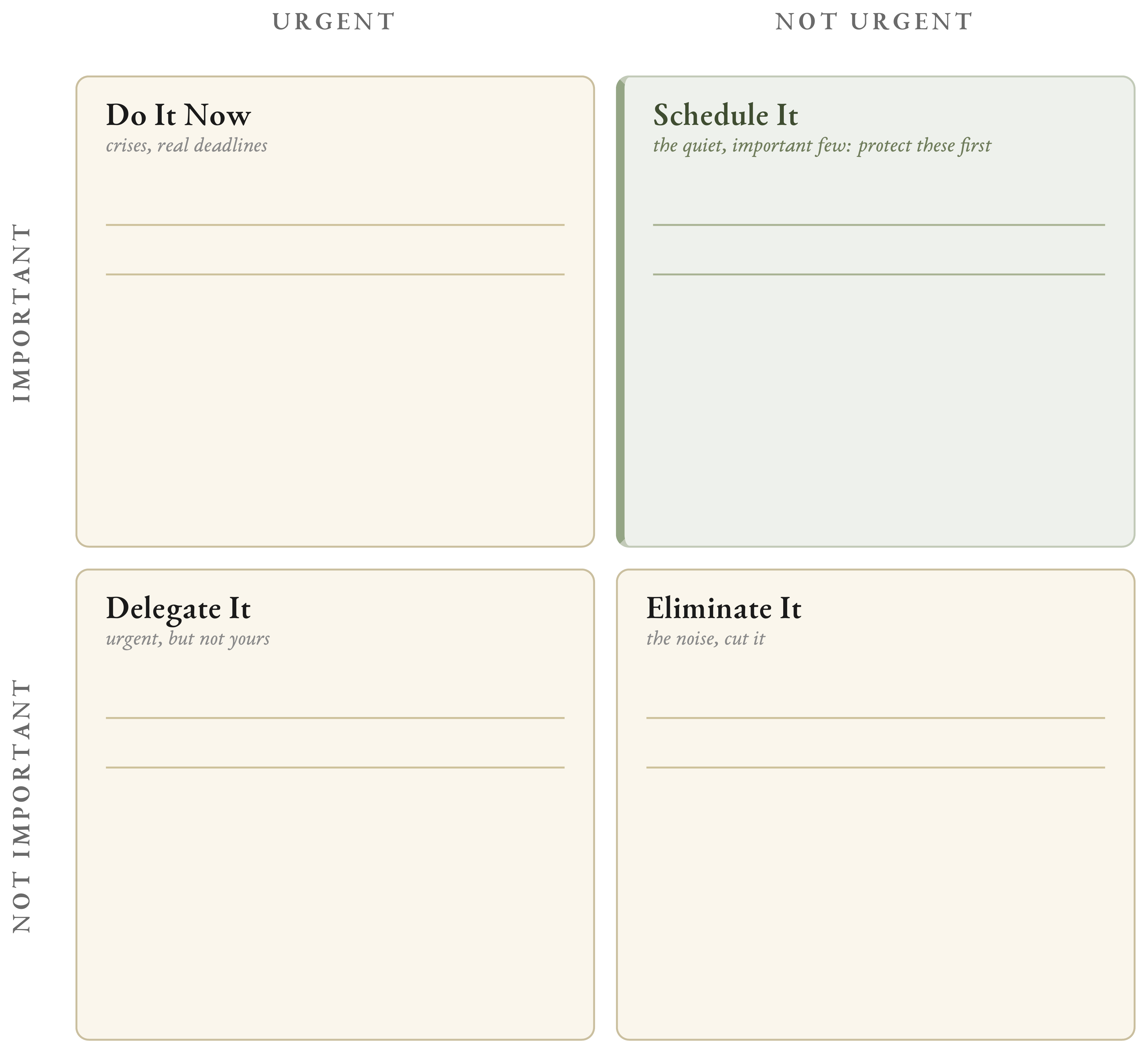
The blank matrix, yours to run. Find your number first, then sort what fills your week into the four boxes. Guard the quiet, important few in Schedule It, and drop them in before the noise can spend your hours.
Open the Priority Sort
Chapter Six and Chapter Fourteen covered why your I AM statements matter, why a careless one works against you, and why it’s important that you use your own voice. This section teaches you the how. How to write, record and use them.
The reason you record them is that when you have a flat day, and you will, the recording will do the work. Record it once at your best and every playback hands you that version, whatever kind of day you wake up to.
| Do | Don’t |
|---|---|
| Present tense, start with “I am” | Future tense (“I will be the best”) |
| One idea per statement | Stack several into one line |
| Phrase every one as a positive | Put “not” or a negative in it |
| Target the area you’re building | Program what is already solid |
| Aim at who you’re becoming | Cap it at who you are today |
| Start with seven to fifteen (about a minute) | Cram in everything and run long |
| Record it in your own voice | Read a cold sheet each morning |
| Use your phone’s plain voice recorder | Fuss over music or a special mic |
| Stand up and move to find the energy | Read it flat and stiff |
| Full stage energy | Mistake loud for energy |
| Keep the energy up to the last word | Let it sag when you get self-conscious |
| Pause between each statement | Run them together like a grocery list |
| Rename it, keep it one tap away, play it daily | Bury it in a folder and forget it |
One rule is paramount, because people get it backwards. Phrase every statement as a positive. The mind does not hear the word “not,” it simply skips it. When you say “I’m not fat,” what you just told yourself is “I am fat.” Say “I am not drinking soda” and you told yourself “I am drinking soda.” The negative now programs the exact opposite of what you meant. So flip it to what you do want: “I’m not fat” → “I am lean,” or “I am a person who only drinks water.”
This needs no gear or talent, and that is for a reason. If you ever show someone how you did it, they should never think it is beyond them or too hard to copy.
To help you get it right, with the right amount of energy and intentionality: picture yourself on a stage in front of a huge crowd, or on a podcast. You are being asked what turned your life around, and you take the mic and deliver your “I am statements” right there. That’s the energy you want.
A few tips:
This too will feel strange and new. Play it once in the morning as you get up, and once at night, the last thing before you go to bed. And any time the Narrator’s voice gets loud, play it too. The first few times you do that, it will feel like a lot. Keep going. It earns its keep in the bad moments. People have shared that they played theirs eight times in two hours to climb out of a spiral. This kept a bad moment from taking over and ruining the entire day.
The aim, in the long run, is for it to get so familiar you barely need to press play. The same way you know every word of a song you heard repeatedly, think of the Happy Birthday song. Same mechanism, except this time you picked the words. I can still recite mine from years back.
To sum it up:
The Narrator rarely appears the same way twice. It wears a mask so its line sounds reasonable. Name the mask out loud and it loses its grip.
Back in Chapter One we met the sneakiest mask, the one that hides in the small words you don’t notice yourself saying. These words sound like updates. They’re usually surrender speeches. Catch the word on the left, trade it for the version on the right.
| Catch | Trade it for |
|---|---|
| “later” | today, or a real time |
| “soon” | by when |
| “someday” / “one day” | a date, or admit never |
| “eventually” | by when |
| “at some point” | schedule it |
| “tomorrow” (as a reflex) | now |
| “when things calm down” | they won’t; now |
| “when I have time” | make the time; block it |
| “after I finish X” | start now; decouple it |
| “once I’m ready” | you won’t feel ready; start |
| Catch | Trade it for |
|---|---|
| “I’ll try” | I will, or I won’t |
| “we’ll see” | yes or no |
| “maybe” / “perhaps” | decide |
| “hopefully” | I will |
| “I guess” | I will, or say no |
| “if I get to it” | I will, at a set time, or I’m not |
| “I’ll try my best” | I will do X by this date and time |
| Catch | Trade it for |
|---|---|
| “I should” | I will |
| “I need to” | I choose to |
| “I have to” / “I’ve got to” | I choose to |
| “I must” | I will |
| “supposed to” / “ought to” | I will, or drop it |
| Catch | Trade it for |
|---|---|
| “just” (“let me just…”) | name the real task |
| “only” | cut it |
| “kind of” / “sort of” | say the real thing |
| “a little” / “a bit” | be exact |
| “real quick” | it’s not quick; own the time |
| Catch | Trade it for |
|---|---|
| “might” | will or won’t |
| “could” | will |
| “may” | will |
| “possibly” | decide |
| Catch | Trade it for |
|---|---|
| “I can’t” | I won’t, or I’m choosing not to |
| “never” / “always” | be specific |
| “impossible” | hard; take the first step |
| “everyone” / “no one” | who exactly |
| Catch | Trade it for |
|---|---|
| “it didn’t happen” | I didn’t do it |
| “things got busy” | I chose other things |
| “life got in the way” | I let it |
| “I ran out of time” | I didn’t prioritize it |
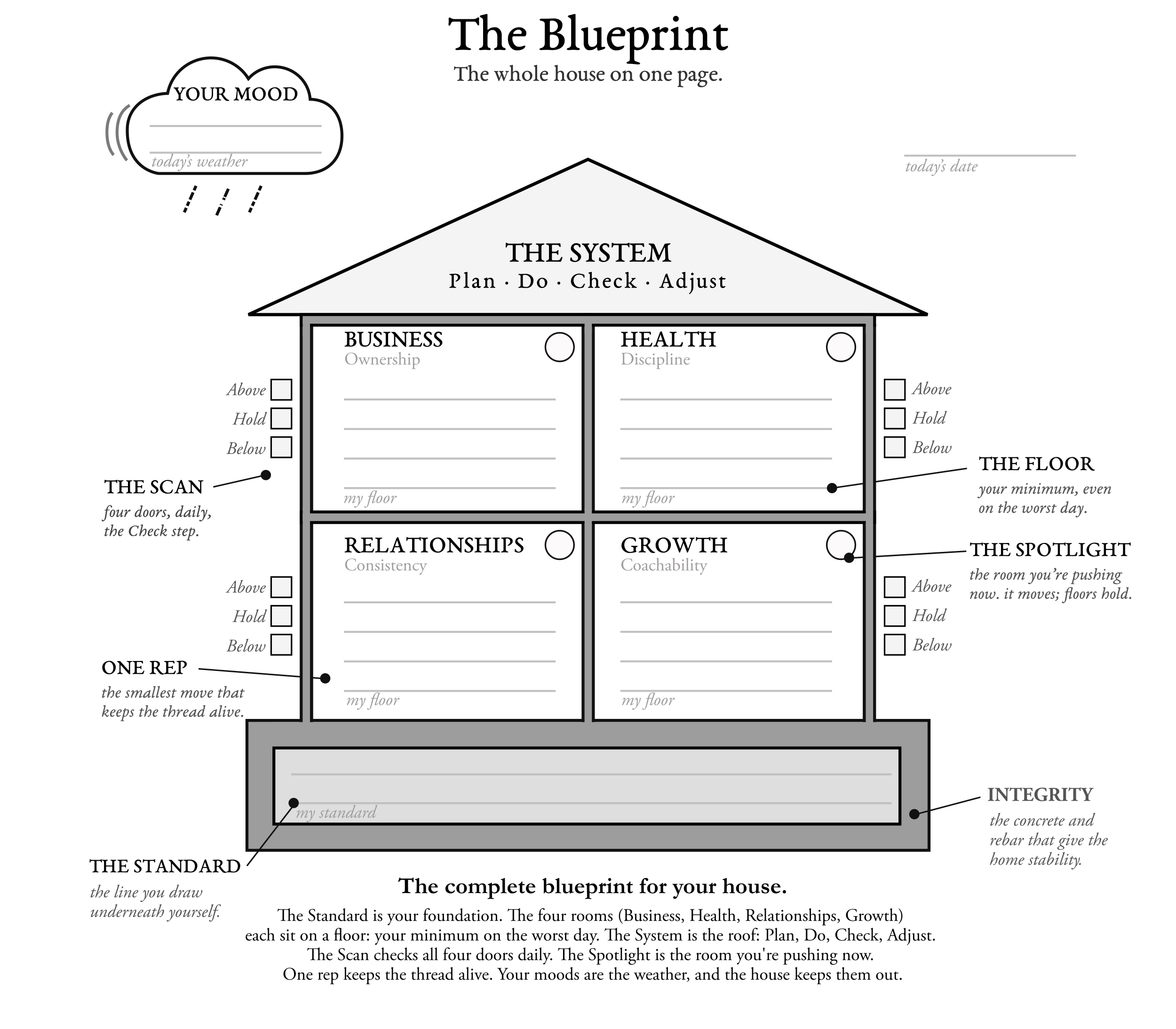
The blank one, yours to fill in. Write your Standard on the foundation, name your floor in each room, mark tonight’s Scan at each door (above, holding, or below), and put the spotlight on the one room you’re pushing now.
Open your Blueprint
Plan, Do, Check, Adjust, pointed at one day. Run it at night on today, or in the morning on yesterday. The last question is the one that changes tomorrow.
The system runs on six terms. Everything else here is the rooms and their pillars, and a handful of names for what you meet along the way. If you keep six, keep the first six.